Thursday, September 24, 2009
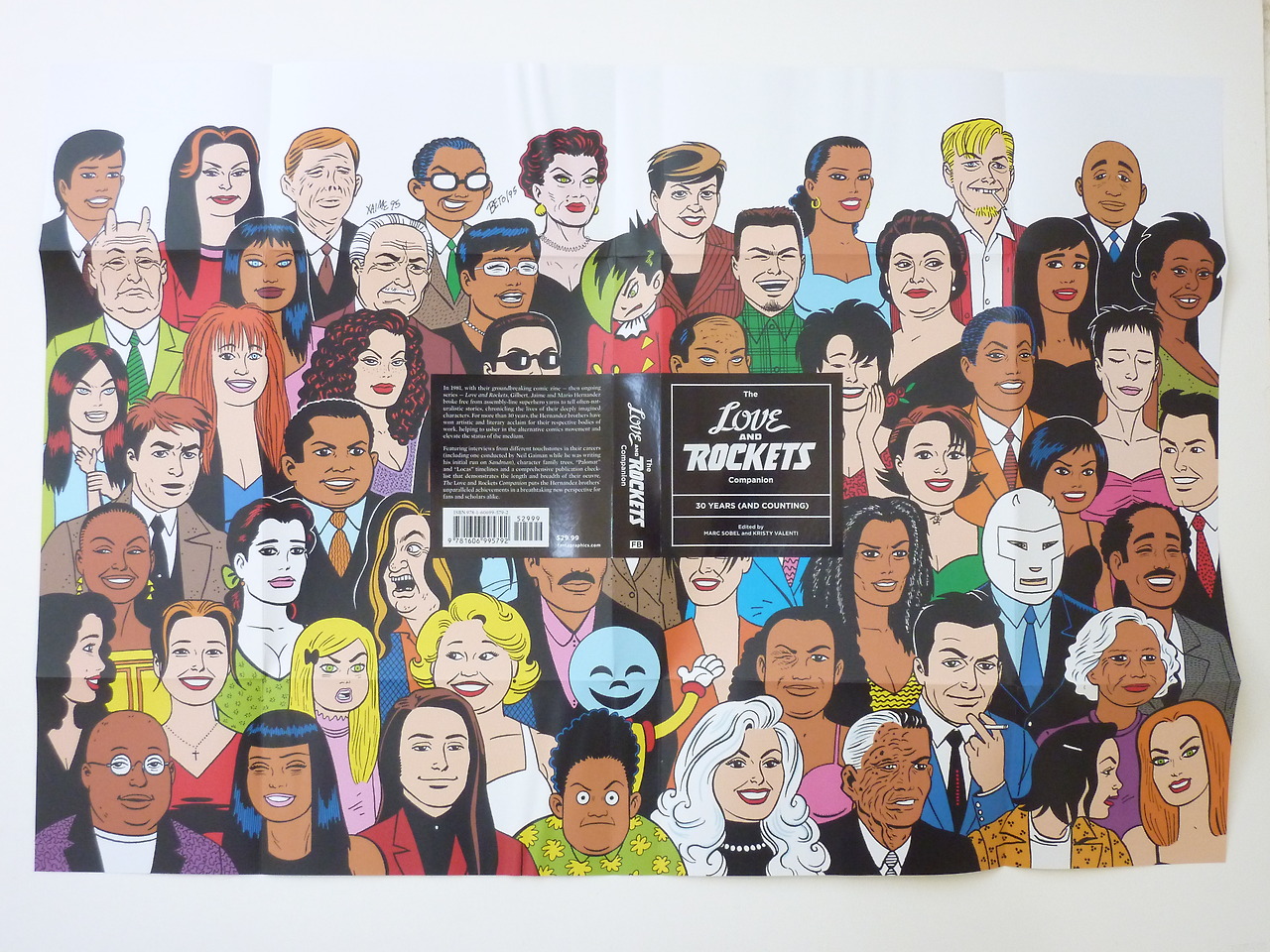
GIANT SIZE Hernandez Bros!

Friday, September 18, 2009
A Quick Update
2) Somebody recently said to me that they were sorry to hear that I'd given up on Shelf Life, my column about the first volume of Love & Rockets. Actually, nothing could be further from the truth; however, while I have stopped posting updates online for the time being (until I find a better host than blogger and get a little more organized), I am plowing ahead. In fact, I'm actually nearing the finish line, at which point I plan to start editing the whole thing for publication.
3) I also have a few reviews which will be appearing in print form very, very soon. Stay tuned.
4) Have I mentioned that you can read my comic, The Red Stiletto for free? That's right! Every day is Free Comic Book Day here at Unattended Baggage. The link's here (and on the sidebar), so please check it out and let me know what you think.
5) And finally, in addition to everything else, I am currently collaborating on a little sci-fi web comic with an artist which I hope will be debuting in early 2010. I don't want to say too much more at this point, but stay tuned for more info soon. I'm very excited to share this project with the world.
Wednesday, August 19, 2009
Friday, August 14, 2009
This One's Been Sitting in My Draft Posts for Months...
One of my favorite series was Vanguard Illustrated, a short-lived sci-fi heavy anthology from the equally short-lived Pacific Comics, published from 1983 to 1984. Vanguard only lasted seven issues, but it gave many talented artists a showcase relatively free of editorial shackles, with some of the highest production values available at the time, and the results were often impressive. I recently re-read this series to see how well the whole thing stood the test of time, and while many of the stories don't seem quite as innovative as I remembered them, the artwork is still exceptional.


The highlight of the series was the three part "Freakwave" story by Peter Milligan and Brendan McCarthy which appeared in the first three issues. The futuristic tale is set in an ecologically devastated ocean-world where survivors live on man-made islands and boats. The story focuses on the Drifter, a loner seeking revenge against a pirate who wronged him. Milligan's prose is suitably gritty and note perfect in its descriptions of this ravaged and savage world, but the real attraction is McCarthy's astoundingly imaginative artwork.
McCarthy's use of color was revolutionary at the time, as was his ability to distort and exaggerate perspectives. This psychedelic panel above is just one incredible example.
The sheer imagination that McCarthy put into world-building was like a firehose to the eyeballs. Each panel is rich with technicolor details and beautifully imagined dystopias (Kevin Costner's Waterworld was accused of stealing designs).
In certain places, McCarthy also used rune-like symbols and oddly misshapen panels to enhance the futuristic and "freaky" tone of the story.
McCarthy's character designs are like manic eye candy, dense with bizarre, esoteric details. Check out the ridiculously over-the-top "Mickey Death" panel above. In the future world of "Freakwave," brutes wear artificial horns with hanging pez dispensers, and huge road signs on their chests.The only disappointment in this story was the cop-out ending, which was controversial with fans as evidenced in the letters pages of later issues, but Milligan and McCarthy would rectify this situation by returning to the world of "Freakwave" again in Strange Days, which was published by Eclipse Comics (who assumed publishing duties for many of Pacific's comics after the company folded).
Vanguard Illustrated also featured a couple above average short stories written by newcomer David Campiti (who later went on to co-found Innovation Publishing) and illustrated by Tom Yeates (one of the most under-appreciated artists in comics). "Libretto," in issue #1, focused on the concept of a planet's gender, an interesting idea that worked very well in this short piece. Yeates' detailed linework (with inks by Rick Bryant) is reminiscent of Wally Wood and Al Davidson, and would have fit perfectly into an issue of Weird Science Fantasy.
"Be It What It Will, I'll Go To It Laughing," Campiti and Yeates' other story (which appeared in the third issue) is a loving homage to Ray Bradbury and several other science fiction writers, and while the story itself is a little erratic and hard to follow in places, Yeates' artwork, especially his figure drawing, is reminiscent of Hal Foster in its stunning photo-realistic detail. Interestingly, Bradbury wrote a letter proclaiming that the story had him "in tears."
The series also featured "Encyclopedias," an early four-part collaboration between Mike Baron and Steve Rude, the award-winning team that went on to create Nexus. I actually enjoyed this story quite a bit. It's a clever, comedic twist on the dystopian future genre - a rookie encyclopedia salesman is dropped into a suburban hellzone with the mission to sell or die.
This panel below is an example of just how talented Rude was right out of the gate. His fight scenes are full of dramatic energy, yet somehow remain grounded and natural!
Baron also wrote another story called "Quark" which appeared in the fourth and fifth issues. It was a fairly generic superhero story with some nice artwork by newcomer Rick Burchett (and great pastel colors by Marcus David), but when Vanguard was cancelled, the story was left unfinished.
The series also included several other random short stories of varying quality. In most cases, the stories were generally forgettable, but most, if not all, featured above average artwork. Here are a few of the many highlights:
"Legends of the Stargazers" (issue #2) - This story, also by Campiti, is silly and kind of hard to follow, but I really liked Bob McLeod's illustrations of over-the-top fantasy mixed with space women in lingerie.
"Adventures in Art" (issue #5) - Rick Geary contributed a couple of excellent short strips that were pre-cursors to his later work in Eclipse Magazine, Cheval Noir and many other anthologies.
"A Tangled Web" (issue #4) - I really liked this creepy little horror story about a grandmother stealing her granddaughter's body. It was written and illustrated by one Ruth Raymond, who unfortunately, to my knowledge, hasn't done any other comics.
"The God Run" (issue #6) - In addition to "Freakwave," Peter Milligan also wrote an excellent little short story about space madness, which featured dynamic art and colors by George Freeman (co-founder of Digital Chameleon coloring and inking studio).
"The Struggle's End" (issue #6) - Rex W. Lindsey, who would later go on to work on numerous Archie books, contributed two highly imaginative stories featuring some visionary artwork.
"The Trains Belong To Us" (issue #6) - George Perez illustrations for Joey Cavaleri's silent four-page, short story about teenage vampires are among some of his best.
"Doc Stearn...Mr. Monster" (issue #7) - Finally, many people may not realize this, but the seventh and final issue of Vanguard Illustrated featured the first appearance of the cult-classic character, Mister Monster, by Michael T. Gilbert and William Loebs.
In the big picture, I know Vanguard Illustrated may not be the best anthology published during the early days of the alt-comix movement. Eclipse Magazine and Eclipse Monthly, Taboo, Anything Goes, Crisis, Cheval Noir, Prime Cuts, Drawn and Quarterly and, of course, Raw, are all probably better in terms of the overall volume of quality content they published. But Vanguard Illustrated is a great little title with lots of hidden gems that make these issues worth tracking down.
Sunday, July 12, 2009
Read The Red Stiletto Online
I've created a Picasa web album of my mini-comic The Red Stiletto, so please check it out and tell me what you think.
Tuesday, June 30, 2009
Practice Makes Perfect


Saturday, June 27, 2009
Review #3
Sunday, June 21, 2009
Review #2
Monday, June 15, 2009
Lessons of an Amateur Cartoonist
- Comics are incredibly labor-intensive. I already knew this to an extent, but I now understand it on a whole new level. Chris Ware's infamous description of comics as "life-eating exercise" resonates with me in a whole new way.
- Knowing that most readers will only spend a few seconds per panel, despite the hours devoted to perfecting each image, can be demoralizing, but I suspect that most comic artists are, to some degree, perfectionists and just can't help themselves.
- Every single line on the page represents a conscious decision by the artist. Every single one! No reader (or critic), no matter how diligent, can ever appreciate the thought that goes into each panel.
- Many of the lines that are NOT drawn are also conscious decisions.
- It's sometimes hard to know when you're finished with a particular image.
- How and when to vary the weight of each line (i.e. the pressure applied with the pen to alter line thickness) is also a conscious decision, and this has a tremendous impact on how the finished product looks. I know this is common knowledge, but actually applying it myself gave me a whole new appreciation for the importance and difficulty of this subtle artistic technique.
- Maintaining perspective (keeping all of the objects and figures in the panel in proportionate size to each other) is much harder than it looks.
- Hatching evenly and consistently is also much harder and more time-consuming than it looks. I love hatching, but I have a whole new appreciation for artists like Frank Miller (go back and look at Ronin!), Karl Stevens, John Hankiewicz, etc.
- Contrary to my preconception, inking is much harder than penciling. However, inking is also far more rewarding than penciling. The permanence of ink is unforgiving (though Photoshop allows some flexibility) and merely tracing over pencil lines doesn't cut it. Inking is fleshing out shapes and shadows and adding texture and tone. I know I have a lot still to learn about inking, but doing this comic gave me a whole new appreciation for the critical role inkers play in the creative process.
- The great artists make it look easy, but that doesn't mean it is. As Jaime Hernandez once said, “There’s a lot of work and thought and all this agony and pain that turns into that one perfect little line.”
- Drawing comics is hard on the body. It strains the eyes, hunches the back, and cramps the hand.
- There are literally hundreds of different types of inking pens and brushes available, and the choices that artists make greatly impact the look and feel of the finished panel. Not only does the weight and fluidity of the line itself depend on this choice, but also the combination of pens used in tandem with each other, to emphasize certain details, relegate others, snap objects to the fore, etc. - all of these are subtle effects that play into the readers’ experience of the image, but that most, if not all critics, myself included, are largely ignorant of. And, of course, the discussion of tools only grows more complex when considering colors and shading. Many people have written extensively about these types of decisions, but all of this is to say that, in creating my own comic, I became acutely aware of the way choosing the right pens can have a dramatic impact on the finished product.
- Proper tools also make life much easier. I really could have used a drawing table (I drew Stiletto seated on a pillow hunched over a coffee table), a desk lamp, a French curve, a clear ruler, oversized Bristol paper (Stiletto was penciled and inked on regular laser paper), more varied types of pencils and pens, brushes, etc.
- Hand lettering is a good way to avoid typos (in the end, I opted against hand lettering for fear that it was too messy and hard to read, but I did attempt it).
- Asking your wife to pose for 200+ reference photos can be hazardous to your marriage.
- Despite what I've read online in a few places, I think using reference photos is perfectly acceptable (Norman Rockwell did it; Crumb too). It's just one of many artistic choices and can add to the realism of the scene. Tracing photos, as I did for several of the panels in Stiletto is, admittedly, a crutch, but can still be a valid tool to tell stories visually. However, in my case, I think I over-relied on the photos to the detriment of the images. In a few places, the art feels flat and lifeless to me.
- There is a huge difference between drawing with the wrist and drawing from the shoulder. I have no idea how to do the latter.
- The difference in the creative pace of writing vs. drawing is staggering. Writing is a quick and prolonged rush of creative energy, where illustrating is a slow, tedious grind. In fact, I think it’s difficult for writers to grasp just how slow a process it is, and how much attention and focus is required. In making The Red Stiletto, it was not unusual to spend anywhere from 1-3 hours penciling and another 1-3 hours inking a single panel. Reconciling the two disciplines was perhaps the greatest struggle I had with Stiletto. Forcing myself to slow down and take my time on each image was indescribably difficult, though I did manage to get into a rhythm toward the end. Generally, the slower I draw, the more precise and controlled my line is, yet the writer in me gets impatient and is always whispering somewhere in the back of mind to move quickly.
- Music is essential to the artistic process. Creating comics in silence, for me, is nearly impossible, and TV is far too distracting (though baseball games were good). Music focuses my attention, relaxes me mentally, and carries me through long stretches of work. Much of Stiletto was drawn listening to Tom Waits, Johnny Cash, Bob Dylan and Patty Griffin.
Throughout the creation of The Red Stiletto, I constantly reminded myself that regardless of what anybody thought of the final product, there was value in the journey itself because it would give me an inside appreciation for the cartoonist's craft. By creating my own comic, I hoped, if nothing else, I would become a better writer about comics. A lot of these “lessons” may be laughable to established professionals, but to me, these were valuable things I needed to learn.
In that sense, I’m happy with the end result.