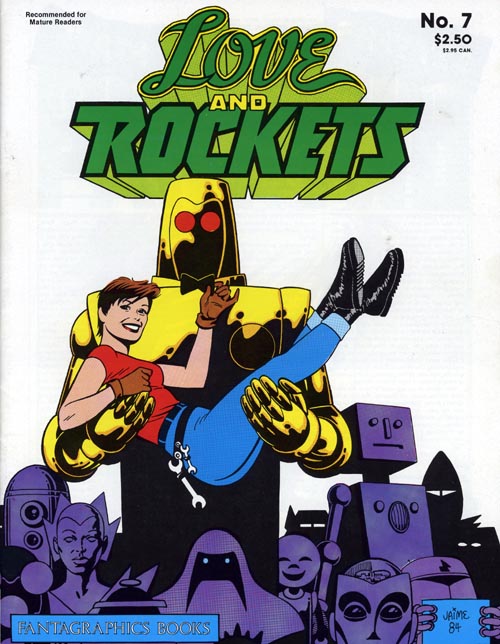
 The latest Shelf Life, which looks at Love & Rockets #7, is now up at Sequart.

Sunday, October 29, 2006

Tuesday, October 24, 2006
Baggage Check: Autopsy Press, EBay, Cardinals, DMZ
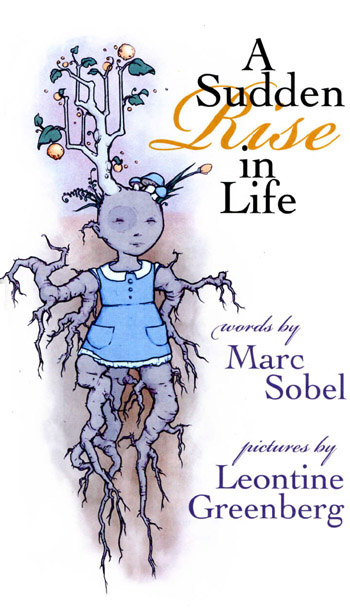 It’s been a while since I last blogged at you, but rest assured that lots of writing has been going on. First and most foremost, my new book is finally ready! It’s called A Sudden Rise in Life, and features a short story and five poems, all illustrated in full, eye-popping color by the incredibly talented Leontine Greenberg. The title story was originally published in Fortune’s Fools, an excellent little anthology of short stories based on fortune cookie fortunes. I also have a new website: Autopsy Press where you can order a copy of A Sudden Rise in Life (with Paypal) and some of my older books as well.
Other projects are also moving along. A new Love & Rockets column (#7) is finished and being edited as I write this, and I’ve read tons of stuff, both old and new, books and comics, which I will try to review in the not too distant future. Still, I have to admit, it’s kind of nice to be off the new comics treadmill for a while. The industry has grown so much in the last five years, it’s all I can do just to keep up with what Fantagraphics and Drawn & Quarterly are publishing.
Considering how much stuff I have in my collection that I’ve never read, I’ve cut way back on my new comics purchases. I haven’t walked away from new comics completely, I’m just slowing way down. I’ve limited my visits to the comics shop to once a month, and am only really following titles which I love, like Walking Dead, Y: The Last Man, Ex Machina, All Star Superman, Escapists, etc. There are also those titles which come out infrequently but I will always get, like Berlin, Kabuki, Optic Nerve, Palookaville, Strangehaven, Stray Bullets, Mome, etc. But for the most part, I have dropped most books, including virtually all superhero stuff, am trying not to get hooked on too many new mini-series, and am limiting myself to only one new graphic novel a month (though, addict that I am, I ended up buying both Chicken with Plums and Shenzhen: A Travelogue From China this month). Last month I ended up going with the 9/11 Report, which was very interesting, and well worth reading, even if I felt a little strange about the whole thing. I will try to gather my thoughts into a more cohesive reaction at some point, but this is definitely a book worth reading if you are curious how many different ways our bloated, complacent, mismanaged government dropped the ball.
As I mentioned last time, I’m also reading books again, which is something I had gotten away from for a while when I was really in the Crack Shots swing. Right now I'm about halfway through J.D. Salinger's other classic, Franny and Zooey, and I just finished reading White Rat, Whitey Herzog’s autobiography about his life in baseball. Whitey was the manager of the St. Louis Cardinals teams that won the 1982 World Series and lost both the ’85 and ’87 Series in seven games each. He’s a surprisingly good writer (helped by ghost writer and local columnist Kevin Horrigan), a no-bullshit, tell-it-like-it-is narrator, and his take on the behind the scenes of a baseball club is pretty interesting. You don’t have to be a Cardinals fan to enjoy it, but it probably doesn’t hurt.
Speaking of the Cardinals, I am ecstatic to see them back in the World Series. Not many people gave them a chance to beat the Padres or the Mets, much less the Tigers, but I think they can do it. Even if they lose, though, nothing will take away the pure joy of that NLCS Game 7 in Shea Stadium. As far as baseball games go, that was a true classic, a 10 out of 10, a game where every pitch carried with it the entire hopes and dreams of a season for both teams, and as the ninth inning approached with the game still tied, the pressure was almost unbearable. And then Yadi hit that homerun...
 I was at a local bar in NYC with about 30-40 other displaced Cardinals fans and when that ball went over the fence, we erupted in a joyous, raucous group hug not unlike the ones you see teams do when they clinch the pennant. But, ten minutes later, when the Mets loaded the bases in the bottom of the ninth, we all sat there stunned, holding our breath with each pitch until the celebration began the second Adam Wainwright’s nasty curveball hit Molina’s glove, striking out the biggest Cardinal killer of them all, Carlos Beltran. Here are some great pictures from that night, and the drunken, champagne-soaked euphoria that ensued. For Cardinals fans, who Whitey himself describes as “the best fans in baseball” (and he should know, having coached for about 12 different teams), it was a crazy, unforgettable night.
But enough about baseball. This is supposed to be a comics blog, right?
Well, I’m still feeling pretty overwhelmed with all the comics I shipped back from St. Louis. I’ve finally gone through everything and unofficially shanked about 17 short boxes of comics, or roughly half my collection. Now I’m slowly going through and listing it all on EBay, a tedious, thankless, frustrating process to say the least. I’ve learned a lot, though and it’s interesting what sells on EBay and what doesn’t. For example, as a general rule, Rob Liefeld stuff does not sell. Why I even bothered to list it, I’m not sure, since I knew no one would want this crap, but I guess hope springs eternal. Anyway, it looks like I’m stuck with my NM copies Youngblood. Nick Fury vs. SHIELD, that atrocious six-issue prestige mini-series from a few years ago also didn’t sell. Of course, that’s not surprising since it sucked, but the covers were beautiful at least. Also, apparently nobody wants Mark Hamill’s horrific mini-series The Black Pearl and I didn’t even bother listing Secret Wars II.
 But surprisingly, I’ve still managed to make some decent money off some stuff. Newer stuff is always easier to move. For example, my copies of DMZ #1-11 were pretty hot. Yes, I finally gave up on this series (and it’ll probably win an Eisner now that I’ve dropped it). There were parts of it I really liked, including its high concept and Wood's innovative and striking covers, but the core story just wasn’t working for me. The characters were too generic, as was the artwork, and I never felt like I was able to buy into the whole “militia war” idea, which seemed muddied, confusing and somewhat contrived. Living in NYC, I also felt like there were a lot of missed opportunities in the artwork. One scene in particular stands out that was supposed to be set in Union Square, but Burchielli’s generic art seemed like he’d never even seen a picture of the square.
Anyway, full runs, complete mini-series, and “key issues” also sell pretty well, which I’m sure is no surprise to anyone. I sold a lot with a whole bunch of key Thor issues, including Simonson’s classic Beta Ray Bill first appearance. (I never understood why that was such a classic, by the way. A duck-billed Thor? Just seems kind of silly to me, but it was very popular back in the day I guess). I also unloaded 66 random issues of good, ‘80s 2000 AD magazines. There’s some great stuff in there by Alan Moore, Grant Morrison, Dave Gibbons, Peter Milligan and dozens of other well known British creators. Not their best work, given the genre and format, but still, some surprisingly fun and original stories. Somebody out there is going to have fun trying to track down the missing issues to fill out some of the story arcs.
Anyway, thanks for checking in and I hope to be back on some kind of semi-regular reviewing/blogging/rambling schedule in the not too distant future.
Thursday, October 12, 2006
Review: Capacity #6
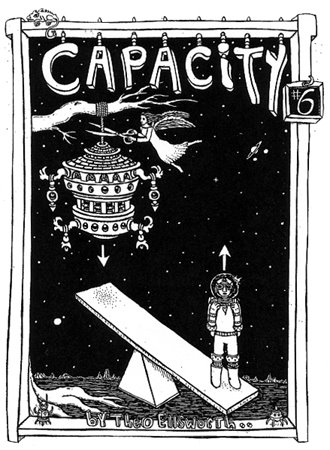
Capacity #6
By Theo Ellsworth
Self Published, US$3.95
Although it's about a year old, one of the best mini comics I’ve read recently (besides Jesse Reklaw’s outstanding Couch Tag #3 which you should go order right now), is Theo Ellsworth’s Capacity #6. I discovered Ellsworth's book, quite accidentally, during a recent trip to Portland, Oregon in August. Portland is famous for its Saturday Market, an extensive street fair downtown which features tons of musicians, food stalls, street performers and arts and crafts. It’s a great, Bohemian kind of scene, and I just happened to find Ellsworth sketching by himself in a small booth near the restrooms. After a quick glance at his books, I could tell he was far more talented than your average mini-comic artist, so I asked him which of his books he was most happy with. Not surprisingly, he recommended the newest issue, #6 (though since that time, #7 has also been completed), which I bought, along with the first issue, thinking I could always go online and order the rest if they were any good.
 Well, they are much better than good. In fact, Ellsworth is such an incredible draftsman, he’s bound to be discovered by the crew at Fantagraphics or D&Q sooner or later. His artwork is reminiscent in some senses of David B’s Epileptic, though it’s more free-spirited, and certainly more richly textured. There’s also a healthy dose of Jim Woodring mixed in there, though more in the bizarre concepts and characters than in the actual drawing style. Rather than straight forward storytelling, Ellsworth experiments with visual poems and short strips, including several pages of single panel gags, entitled "Shorts (as Opposed to Pants)." But the real highlight of the sixth issue is the opening poem, "Thoughts" in which the artist strips away all barriers of storytelling and character and simply lets his imagination run wild on the page, accompanied only by the sparse lyrics of his simple rhyme. What Ellsworth is really doing here is exploring the origins and nature of his own thoughts, and the whole thing is filled with fascinating creatures, machines and landscapes so compelling, you literally feel like an explorer visiting some distant planet. Ellsworth’s line control is amazingly precise and his panels are dense with his singular visions, yet despite the meticulous detail, everything is clearly defined. The story also makes clever use of the thought balloon, that ubiquitous storytelling device that is often taken for granted, as he literally surrounds his panels with thought clouds. Ellsworth also hand letters everything in the book, assimilating the text into the art, adding to the overall effect.
Overall, this was about as good a mini-comic as I've found in recent memory, and Theo Ellsworth is an artist with a lot of promise. Unfortunately, it doesn’t seem like his website is setup to take online orders (though you should definitely browse through his online gallery), but you can e-mail him and I’m sure he’ll happily sell you a copy. Grade: 4.5/5
**Also check out Shawn Hoke's review of this issue, with some additional scans, over at his SIZE MATTERS Mini Comics Blog. In fact, Ellsworth is the artist of his blog's logo!
Tuesday, October 03, 2006
Raise High the Roof Beam, Carpenters
 I know it’s been a while since I’ve done any comics reviews (I'll have some soon, I promise!), but lately the novels and short stories seem to be rising to the top of my reading pile. The best book I read recently is J.D. Salinger’s Raise High the Roof Beam, Carpenters, and Seymour: An Introduction. Of Salinger’s four books (he is a famously non-prolific writer, though rumors abound of the many unpublished works that the writer has withheld), this is by far the most obscure and alienating work. It is often the one that literary critics point their finger at when arguing against Salinger’s place in the canon of great American writers.
The book is essentially two novella length short stories, each about 100 pages, both focusing on the same character, Seymour Glass. Serious Salinger fans who have read Nine Stories will recognize that Seymour Glass, and indeed the entire Glass family, are the subject of many of Salinger’s non-Catcher in the Rye writings. In fact, the first story in Nine Stories, “A Perfect Day for Bananafish,” which I reviewed a while back, is about Seymour’s tragic suicide. Here we learn that that story, and several others, were written not by Salinger himself, but by his brother Buddy, and both Raise High the Roof Beam, Carpenters and Seymour: An Introduction offer much more insight into both characters' lives before that tragic incident.
Both stories are narrated by Seymour’s younger brother Buddy. The first, Raise High the Roof Beam, Carpenters, focuses on Seymour’s rather unusual wedding day. The odd thing is, there is no actual wedding that takes place in this story, nor does Seymour himself make an appearance. Instead, we follow Buddy and several of the wedding guests, including the Matron of Honor, her husband, a friend of the bride, and a deaf and mute great uncle, as they travel from the ceremony, which was cancelled due to the fact that Seymour never showed up, to the bride’s parents’ house on the Upper East Side of Manhattan. However, when the group is stranded in traffic due to an unexpected parade, they eventually decide to walk to Buddy’s apartment nearby.
What makes this story so fascinating (and indeed this is the case for all of Salinger’s writing) is the narrator. Buddy’s rather unique voice is strong throughout, and his insights into the eccentricities of his brother’s life, as well as the other Glass children (of which there are seven) is phenomenal. With a surgeon’s precision, Buddy describes each of the siblings, all of whom are at once eccentric, neurotic, highly intelligent, some even bordering on genius, and strangely aloof. That all seven of them were once stars of a popular children’s radio quiz show fits with their loving, yet highly individual and competitive natures. Buddy also gives us a strong description of the afternoon's events. The Matron of Honor compains vehemently about Seymour's abandonment of her best friend, while the others debate the circumstances in a much more rational manor. None, at first, realize that Buddy is Seymour's brother, and once they do, they spend much of the rest of the story trying to understand what kind of man could commit such a horrendous act as to disappear from his own wedding.
Though there is much to praise, Salinger’s prose is the real treat in this first story, as observant and fluid as you would expect from one of the greatest American writers. His ability to leap from character to character, noticing and commenting on the most seemingly insignificant details, only to elevate them later to essential within the narrative, is a fascinating skill. It’s the kind of story you could read several times, each time noticing the deepening layers of character.
The second story, Seymour: An Introduction is a much more difficult pill to swallow. First, it is in no ways a story in the traditional sense. Unlike Raise High the Roof Beam, Seymour does not contain a plot, a linear progression, or even any real action or drama. It is, instead, a rambling, jagged meditation on Seymour’s life, written in a series of faux-diary entries by his grieving brother, Buddy, shortly after his suicide. What the story does do is offer the readers rich details into the relationship between the two brothers, background on their childhood and their brief journeys into adulthood. We learn that Seymour was, among many other things, a poet of considerable talent, having written hundreds of modified haikus, and that Buddy, a thinly-veiled Salinger, is himself the author of many of the short stories in Nine Stories. Buddy’s language in these diary entries is at times fascinating, despite being pretentious, rambling, often long-winded, and occasionally confusing or tangential. A quick glance at the reviews on Amazon.com shows that many readers found the story difficult to complete, occasionally even frustratingly impenetrable. To an extent, I would agree, though there is no doubt that I came out of it on the other side having gained a much richer appreciation for both characters, and a real sense that I had just read the diary of a genius.
In the end, despite my (and many other readers’) frustrations with the second story in the book, I would still highly recommend it. If your only experience with Salinger’s writing was reading Catcher in the Rye in high school, this is well worth a read. Salinger’s real skill is in his ability to convey eccentric characters through the use of language and voice. His much more celebrated book, Franny and Zooey, also a collection of two short novellas, focuses on the youngest two siblings in the Glass family. It’s next on my reading list, and given what fascinating characters the members of the Glass family are, I am anxious to get started.
Subscribe to:
Posts (Atom)